Vítězslava Kaprálová
The Glass RoomVítězslava Kaprálová is one of the few real people to enter the otherwise fictional world of The Glass Room. At the Landauers’ housewarming, she is a fifteen-year-old conservatory student whose assured performance of Ravel’s “Ondine” briefly makes the Glass Room seem to embody an artistic future. Maestro Němec names her and those like her as the country’s promise; the scene’s celebration is complicated by Hana’s blunt recognition that his attention to a fifteen-year-old girl is flirtation.
Identity and Historical Status
The author’s note emphasizes that the novel’s central characters, including Liesel, Viktor, and Hana, are inventions, and that their story has no basis in fact. Kaprálová is a deliberate exception: a historical composer who appears briefly amid the fictional gathering. The note describes her life as tragically short and says it seems emblematic of the brilliant but doomed First Czechoslovak Republic, urging readers to learn more about both the composer and her country. This framing gives her cameo a resonance beyond the party: she belongs to actual history, while the people around her belong to the novel’s imagined account.
At the housewarming, Kaprálová is introduced as the pretty daughter of composer Václav Kaprál. She is already enrolled at the Conservatory and studying composition, remarkable accomplishments at fifteen. The gathering’s musicians and guests regard her as a prodigy, but the narrative also makes her visible as a young woman subjected to their collective gaze: she blushes under it even as she displays composure at the keyboard.
The Housewarming Performance
After Němec has played a piece by Leoš Janáček, mentor to both him and Kaprál, he declines an encore and gestures toward Kaprálová, describing the handoff as passing responsibility to the next generation. The guests respond with a shiver of delight. She takes her place at the piano and chooses “Ondine,” a movement from Ravel’s Gaspard de la Nuit that she is preparing at the Conservatory for her finals—not Janáček, whose influence has shadowed the musicians gathered in Město.
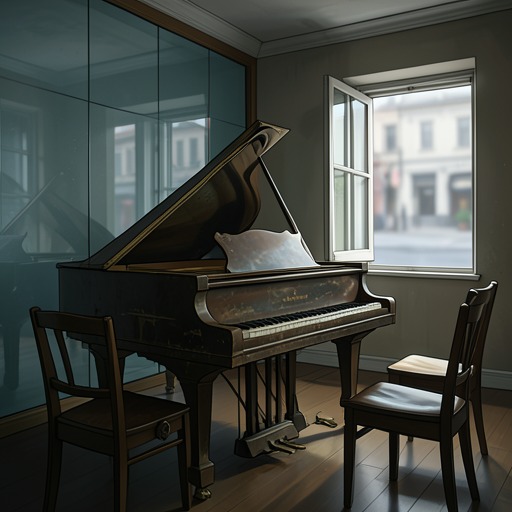
The performance is delicate and wavering, its repeated notes subtle without becoming repetitive. It is closely matched to the room around her: winter light falls through the plate-glass windows, guests move through the space, and their forms appear faintly in the flooring and compressed sideways in the slender chrome-plated pillars. At the piece’s ending, associated with the death of the nymph Ondine, Kaprálová remains still for a moment, hands poised above the keys. Then she turns toward her listeners with a quick, nymph-like smile. The pause makes the ending more than a display of virtuosity: for an instant, the performer holds the room’s attention in stillness before rejoining the watching crowd.
Reception and Gendered Attention
Kaprálová receives even more applause than Němec. The audience calls out praise in Czech, while its admiration repeatedly links her musical assurance to her youth and beauty. Němec bows, takes her fragile hand, described as light as a bird, and raises it to his lips. His gesture sits uneasily beside the scene’s public celebration of her talent: she has just been honored as a musician, but the attention also turns her into an object of adult admiration.
Hana makes that unease explicit. While the applause and social bustle continue, she has moved around the other side of the onyx wall to look out at the cold garden and winter trees. When Liesel comes to stand beside her and asks what she thinks, Hana points to Kaprálová’s age and questions what Němec is doing flirting with her. Her response cuts through the party’s polished language of artistic succession. The same scene that casts the girl as the country’s future also exposes the imbalance between a celebrated adult man and the fifteen-year-old whose performance has captivated the room.
Artistic Promise and Narrative Significance
Němec calls Kaprálová and people like her the artistic future of the country, describing a young nation rich in energy and talent. The housewarming turns that pronouncement into a scene: Janáček’s music evokes an established musical inheritance, while the handoff to Kaprálová makes the next generation audible in the Glass Room. Her choice of Ravel, rather than another Janáček piece, gives the performance its own distinct direction, even as the gathered audience receives it as a promise about the nation’s future.
The author’s note retrospectively darkens that optimism by calling Kaprálová’s life tragically short and connecting her fate to the doomed First Republic. The novel does not develop her biography or make her one of its principal characters; instead, the brief performance concentrates promise, public acclaim, and vulnerability in a single appearance. Kaprálová’s music gives the celebration a moment of genuine artistic possibility, while Hana’s observation prevents that possibility from being mistaken for a world free of gendered power.